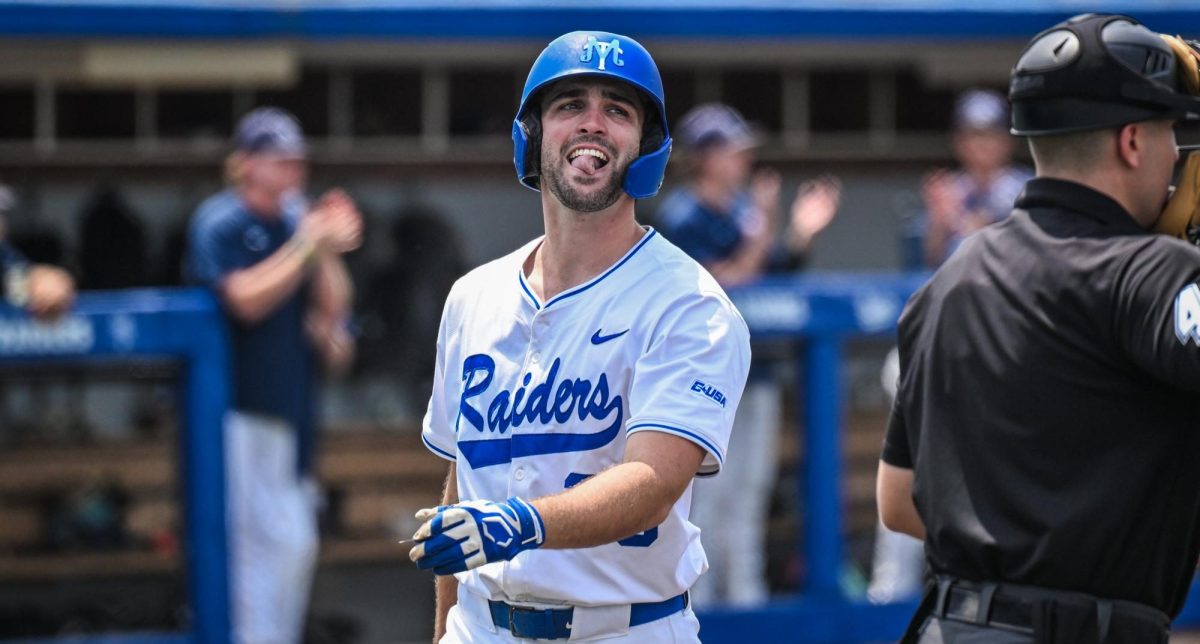
For Braden McPherson, it started last college football season.
Preparing for week one, the MTSU junior downloaded the FanDuel Sportsbook app and quickly placed a $5 wager on one of the weekend’s upcoming games.
“I turned 21 at the very end of August [2024],” McPherson said. “I started dabbling in it in early September just to try it out. Yeah, it just kind of took off from there.”
As the weeks went on, he got a little braver, adding legs to his parlays all while keeping a tight hold on his budget, he said.
“It’s not an everyday thing, maybe a couple of times a week,” McPherson said. “If I see a line or a money line play that I like, then I’ll do it. I look at it as a way to try to pay for things like gas and groceries. Obviously, I’m not going to be able to pay for my rent with gambling.”
Staying levelheaded hasn’t kept the young MTSU student from winning big.
McPherson placed a 10-leg money line parlay during the last week of the college football regular season. McPherson accurately picked the winners of 10 games that week from the likes of Tennessee and Vanderbilt to Ohio State and Michigan, turning his typical $5 bet into a $1,130 reward.
But not everyone is as lucky as McPherson.
In May 2019, the state of Tennessee legalized online sports betting, with sportsbooks in the tri-star state becoming fully operational in November 2020. State law allows for online wagers to be placed on games ranging from many leagues and teams, such as the NFL’s Tennessee Titans, NHL’s Nashville Predators and even college teams like MTSU.
On paper, lawmakers intend for sports gambling to benefit the economy, with the Tennessee Sports Wagering Council serving as a regulating body. The state imposes a 20% tax rate on adjusted gross revenue from sports betting, which substantially contributes to state taxes.
Since Tennessee legalized online sports betting four years ago, the state has seen $14.1 billion in bets placed, generating over $261 million in state taxes, according to Chattanooga, Tennessee, station News Channel 9.
Eighty percent of that tax revenue funds education, while 15% goes to local governments, with 5% going towards mental health funds, according to RG.org.
In practice, however, sports betting’s extremes can do more harm than good. Unlucky bettors often chase their losses and wager more in an effort to regain what they lost.
As of 2025, roughly a quarter million people in the state of Tennessee experienced gambling disorder symptoms, according to The Gambling Clinic. Additionally, only 10% of those with a gambling problem end up seeking treatment.
Gambling addiction itself isn’t new, but with the increasingly widespread legalization of online sports betting, addiction clinics are seeing an influx of younger clients, research assistant Marcos Lerma said.
“Before sports betting was legalized in Tennessee, it was generally an older crowd,” Lerma said of his clientele’s age range. “Forties, 50s, middle-aged, but now that sports betting has been legalized and there’s a bunch of different apps, we’ve been seeing a lot younger clients. Now it’s more of an even mix for sure.”
A clinical psychology doctoral student at the University of Memphis, Lerma actively works as a practicing psychologist at the Tennessee Institute for Gambling Education and Research (TIGER). TIGER consists of two interrelated divisions: a research center, The Gambling Lab, and a treatment center, The Gambling Clinic.
The Memphis-based institute takes a different approach to treating addiction, as, unlike other clinics, TIGER is “gambling neutral,” Lerma said. TIGER creates a more natural transition for addicts by allowing patients to choose their own path.
“Other places might lean one way or another in terms of, ‘no, if you’re going to seek treatment, then you need to cut gambling out completely,’” Lerma said. “With us, we don’t see it exactly that way. If someone wants to come in and do a moderation goal, we can work with that. If someone wants to do abstinence, we can work with that as well. We’re really just trying to help the client get wherever they want to get to.”
Once a goal is set, whether it be abstinence or moderation, psychologists at TIGER highlight gambling “triggers” for individual patients. For a sports betting addict, watching games is a potential trigger, whereas a casino bettor could be provoked by something like a free play waiver, Lerma said. After targeting a catalyst, TIGER helps patients find and focus on other hobbies as alternatives to gambling.
While TIGER and other addiction clinics like it work to end problem gambling, betting companies continue to increase advertising spending. From Aug. 15, 2024, through the first three weeks of the NFL season, America’s three largest sportsbooks, FanDuel, DraftKings and BetMGM spent a combined estimate of $75 million in television advertising costs, according to MarketingBrew.com.
Littered with celebrities and famous athletes, most gambling ads follow a similar premise, with each advertising the company’s own version of “free bonus bets” — added incentives to increase signups.
“[Gambling companies] are good about getting you into it,” McPherson said. “It was like a deposit $5 or $10, then you get $200 back in bonus bets, and boy, they know how to get you hung.”
Sports gambling promotion isn’t just limited to television, however, as radio stations heavily market the growing form of online wagering. Like stations nationwide, Nashville-based sports radio network, 102.5 The Game, and ESPN 94.9 The Fan, aren’t immune to advertising online betting.
Nearly all of Tennessee’s licensed sports gaming operators have sponsored the station at one time or another, 102.5 The Game’s director of sports marketing, Jeff Kolb, said.
On a day-to-day basis, Kolb primarily handles broadcast agreements with the network’s teams, such as MTSU, Vanderbilt, the Nashville Predators and the Nashville Sounds, while most of the “big” gambling advertisers are handled on the national level by ESPN, he said.
The American Gaming Association advocates for “ethical” advertising practices through the Responsible Marketing Code for Sports Wagering. Composed of six rules, the code advocates for AGA members to respect the legal age for sports wagering, limit college and university advertising, support responsible gambling and control digital media and websites when advertising their products, according to Regology.com. Despite this, there’s currently no law in place to ensure that the AGA’s code is adhered to.
“There are some [betting companies] that run a disclaimer at the end of every ad that basically promotes responsible gambling and if you have a problem, here’s an 800 [phone] number that you can call, kind of like an alcoholic situation,” Kolb said. “I’ve noticed that some have that disclaimer on everything, and others don’t have it at all. I don’t know how that works, but that’s their problem as far as from a legal standpoint.”
Regardless of advertising disclaimers being “sped up” or “hard to hear” at times, their inclusion is still important, Lerma said.
“If you really wanted to be more effective in the delivery of the disclaimer message, then generally, nationally, there could be more done in terms of slowing down that fast-paced disclaimer at the end or making it more prominent in video ads instead of just having it at the very bottom,” Lerma said.
If you or someone you know may have a gambling problem, you can call or text The National Problem Gambling Helpline Network at 1-800-522-4700 or chat with a specialist online. Inquiries are answered 24/7 and remain confidential.
Lead photo illustration by Alejandro Castro. Photos by Adobe Stock Library.
To contact the sports editor, email [email protected].
Follow Sidelines on Facebook at Facebook.com/MTSUSidelines, on X @mtsusidelines and Instagram @mtsusidelines. Sign up for our weekly newsletter here.