History flows much deeper than what many see, and this is especially true of the South. Exploring how numerous bodies of water connect to the culture and history of the American South, MTSU students and guests gathered for a showing of “The River: A Songwriter’s Stories of the South.”
Around 7:00 p.m. on Wednesday, Instruments lined the front of a lecture hall in the Business and Aerospace building, and a table covered in posters, CDs and DVDs greeted those entering the room as they prepared for the film’s screening, accompanied by a short performance and Q&A with Ted Drozowski.
Drozowski is the frontman of Coyote Motel, which he describes as a psychedelic roots band that plays all the music featured in the film. When he first imagined the project, Drozowskis saw it as a staged live production with the band playing, accompanied by dancers and specialty lighting. He wrote over 14 drafts of the script before the dialogue of the production evolved into what is in the film, and the transition from play to film occurred during the COVID era.
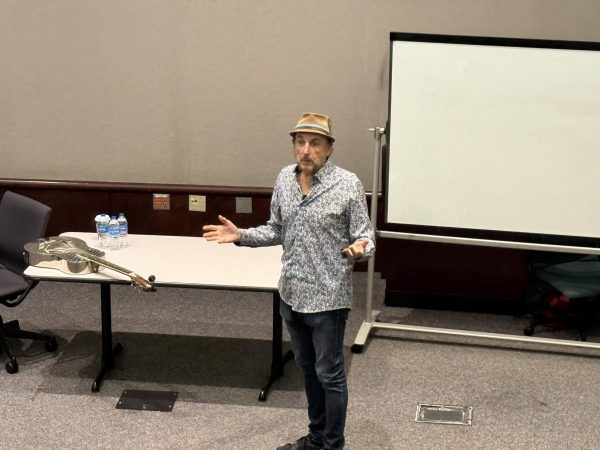
Before beginning the screening, Drozowski referred to his production as a “psychedelic musical cultural documentary.” Bringing to life how the culture of the South is intertwined with the land and how the natural elements of the South tell more stories than people can, he also uses the band’s progressive rock guitar sounds combined with folk and Americana-sounding lyrics to convey how versatile blues is and how it shaped the history of America.
“Blues is like Jazz, this incredibly flexible art form, and you can kind of do whatever you want with it,” Drozowski said after the showing.
Also present was Richie Owens, a friend of Drozowski, who directed the film. Owens has experience playing his own music, as well as producing for a variety of artists in Nashville, and has even worked on shows like “Hee Haw” throughout his career.
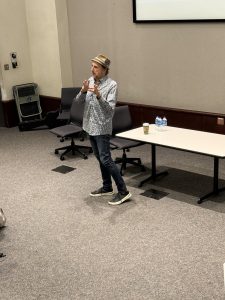
Before pressing play, Drozowski sat with Owens and Bill Steber to perform of two songs from the movie “Black Lung Fever” and “The River Runs Forever” acoustically, bringing out the roots sound as they filled the room with guitars, a harmonica, and even used a bow and a hand saw to acoustically mimic the eerie sound of the theremin played in the film. Steber is a middle Tennessee photographer who captured many of the images used in the documentary.
“The River: A Songwriter’s Stories of the South,” which took over 500 hours of editing to come to life and was completely crowd-funded, begins with the backstory for “Tupelo” and ends with the focus track of the film “River.”
“A few people have pointed out that it’s not the most cheerful collection of songs,” Drozowski said, “but it’s real.”
To contact the features editor, email [email protected].
For more news, visit www.mtsusidelines.com, and follow us on Facebook at MTSU Sidelines and on X and Instagram at @mtsusidelines. Also, sign up for our weekly newsletter here.