You’re reading a story from Sidelines 100, a project showcasing a century of student storytelling at Middle Tennessee State University. Sidelines 100 plans to highlight 100 stories from the newspaper archives this fall and spring.
This story originally ran in the July 9, 2003, edition of Sidelines. Subscribe to our newsletter to stay on top of all things Sidelines 100.
The story has been updated for current basic AP style, but the wording in the story has not changed. Any ideas, perspectives or opinions do not necessarily reflect those of Sidelines.
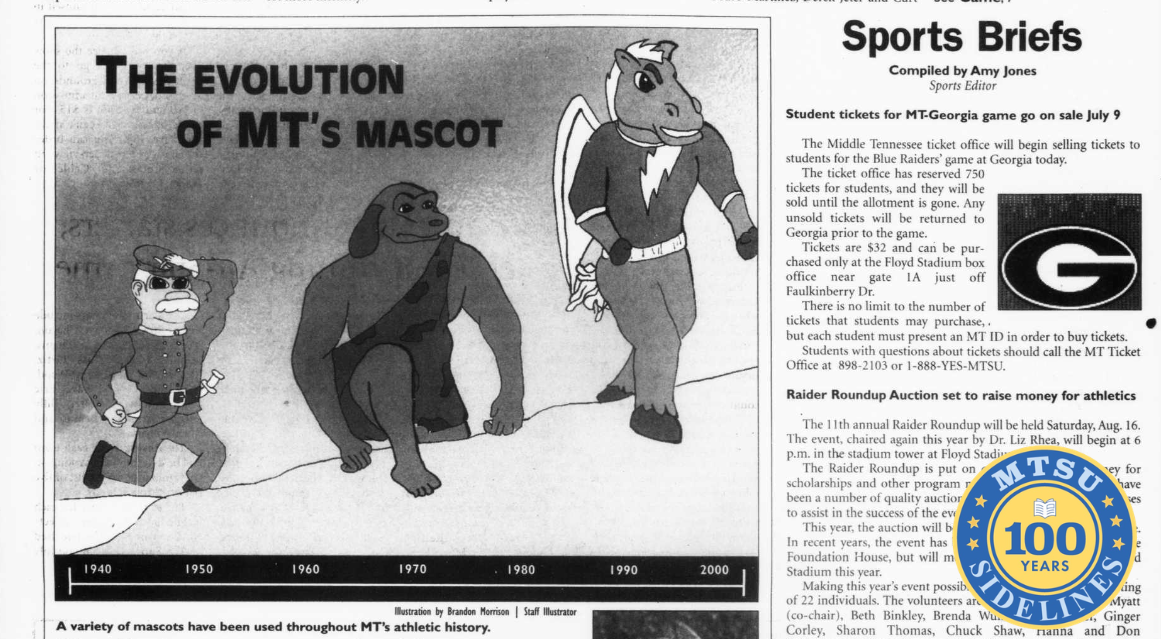
Middle Tennessee has gone through many changes in reference to the athletic nickname, logo and mascot over the years.
However, since 1998, a winged horse named Lightning has been the representation that is noticed at Blue Raider sporting events.
MT first received an identity in 1945 when the university used the symbol of a confederate general Nathan Bedford Forrest. Forrest, who was seen on a horse, held the look of the Blue Raider nickname.
Twenty years later, the Forrest mascot was no longer used because of the sentiment of those who felt it was insensitive to the African-American community.
The actual name of the Blue Raider also has a history behind it. Before 1934, the teams by different nicknames, including the Teachers, the Normalites and the Pedagogues.
The Daily News Journal had a contest for the choosing of the nickname. Charles Sarver, who was a member of the football team at that time, chose the nickname that won the contest and a prize of $5.
Sarver took the name from the Colgate Red Raiders and switched the Red to Blue. The name has been used ever since.
Following the removal of the symbol of Forrest, the Blue Raiders used an unofficial mascot named Ole Blue.
Ole Blue was a cartoon-like blue tick hound that roamed at all the Blue Raider athletic events.
Starting in 1996, Former MT President James E. Walker decided that MT needed a facelift.
A logo and mascot committee was then formed because the members of the university community felt the unofficial mascot was not the proper one.
The committee that was made up of students, faculty, staff and MT supporters met several times during a 23-month period.
During the meetings, discussion of changing the Blue Raider was suggested, but the committee decided to keep it along with the colors of royal blue, white and silver.
“We looked at several different things, several different variations, we discussed different things, ran different drawings. It wasn’t anything that was done in a real short period of time,” Executive Director of Marketing and Communications Doug Williams said.
With the help of Dye, Van Mol and Lawrence, the selection of the logo and mascot was down to two choices were ready to be announced.
The committee was able to make a selection for the new logo and mascot. The revealing of the new logo and first official mascot was Jan. 17, 1998, during the halftime of a men’s basketball game against Tennessee State University.
In the time leading up to the unveiling, there was a campaign including a billboard in Nashville, a commercial on ESPN and posters put up all over campus with the words “Lightning Strikes Murphy Center.”
“Certainly, athletics is an important part of a university. Lightning plays an important role, being a symbol and helping provide entertainment.” Williams said. It is the first official logo in the university’s history.
According to Greek mythology, the winged horse possessed superior cunning and speed.
The thundering horse of the gods was entrusted to carry lightning bolts and could only be harnessed by a noble being with a pure heart. The current MT logo was designed by Chris Brady.
There are no predicted changes in the upcoming future for Lightning or the athletic MT logo.
To contact the Sidelines 100 editor, email sidelines100@mtsusidelines.com.
For more news, visit www.mtsusidelines.com, and follow us on Facebook at MTSU Sidelines and on X and Instagram at @mtsusidelines. Also, sign up for our weekly newsletter here.