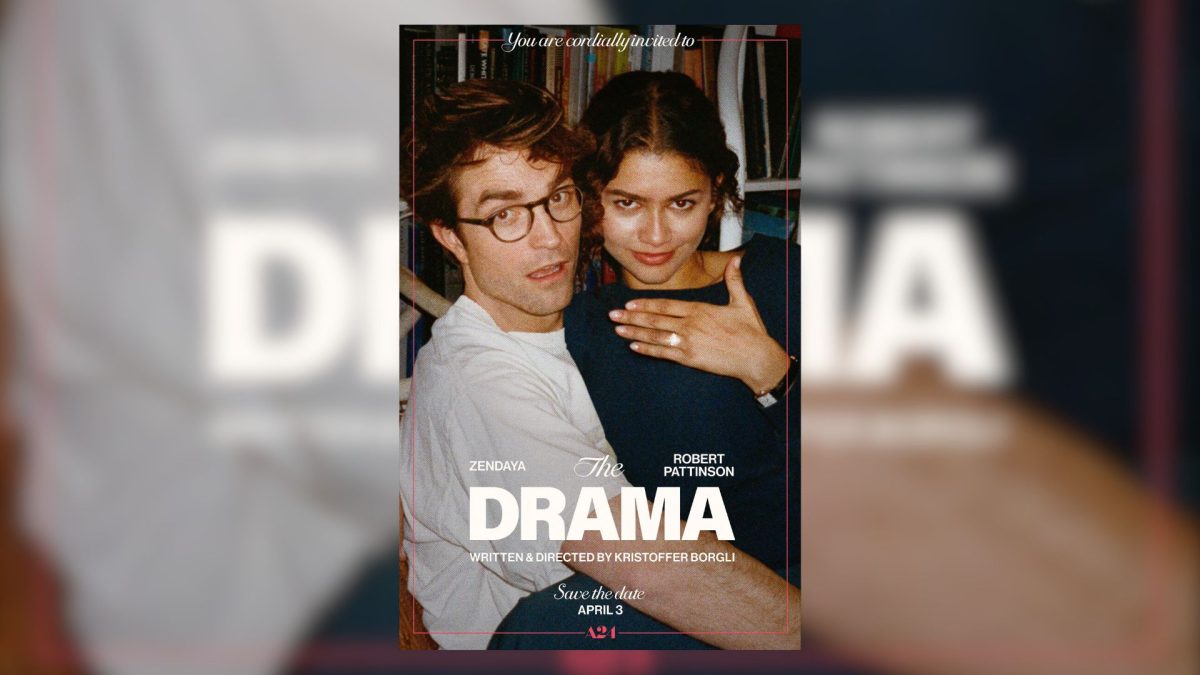
After an elaborate and memorable marketing campaign that started with a mock engagement announcement in The Boston Globe, audiences were cordially invited to meditate on the limits of total acceptance in “The Drama.”
This romantic dark comedy follows the happily engaged couple, Charlie (Robert Pattinson) and Emma (Zendaya), one week before their big day. During a dinner with their friends married couple Matt (Mamoudou Athie) and Rachel (Alana Haim), the group takes turns admitting the worst thing they have ever done. Emma’s confession shocks everyone — Charlie, their friends and even the audience.
What unravels is a jagged, slow descent into confusion and chaos. As Charlie processes his fiancé’s revelation, he struggles to make sense of the person he thought he knew. With their relationship strained, the question now becomes: Will there even be a wedding? If so, can they keep their relationship intact?

“The Drama” challenges audiences to consider their ideas of unconditional love. In theory, it should be easy for a person to say they will love their significant other, flaws and all, but the practice is something else entirely. What happens when you discover something about the love of your life that makes you see them in a different — and in Charlie’s case, negative — way?
The bounds of Charlie’s unconditional love for Emma are certainly tested as he tries to reconcile the woman he thought he knew and her morally reprehensible past. This results in displays of funny yet neurotic behaviors from Charlie, which is a testament to Pattinson’s comedic timing.
The film also observes a controversial aspect of American culture. Its director, Kristoffer Borgli, is Norwegian and grew up in a small suburb outside Oslo. Borgli is no stranger to controversy; after all, he did write an article for a Norwegian magazine where he admitted to having a relationship with a 16-year-old girl when he was 27.
It’s also not surprising to see another non-American filmmaker commenting on American politics and culture. One example of this is British filmmaker Alex Garland’s 2024 dystopian drama “Civil War.”
The difference between Garland’s film and “The Drama” is that Borgli’s observation and critique of this controversial American topic doesn’t make any new claims or add anything constructive to the conversation. It was a superficial look at a topic that has plagued America for much of the 21st and late 20th centuries and was more of a proverbial finger wag than a dog bite.
Ultimately, the shocking twist that drove “The Drama” wasn’t the most controversial part about it.
The story did not sell the commentary it was making, nor did it sell the characters. Those who didn’t pay attention to the marketing may be lost trying to figure out who these characters are, what they do for a living, and how they can afford a high-end brownstone home in Boston.
It may have been Borgli’s intention to purposefully not show much of Charlie and Emma outside of each other, the wedding or the film’s flashbacks, but the lack of access lowers the stakes for the couple. The film may have benefited from a longer runtime and further development of both characters.
Robert Pattinson, Zendaya and the entire cast carry a film whose aim is to provoke, but which has nothing meaningful to say. However, the comedic moments and visual elements are enough to keep people engaged.
To contact the features editor, email [email protected].
For more news, visit www.mtsusidelines.com, and follow us on Facebook at MTSU Sidelines and on X and Instagram at @mtsusidelines. Also, sign up for our weekly newsletter here.