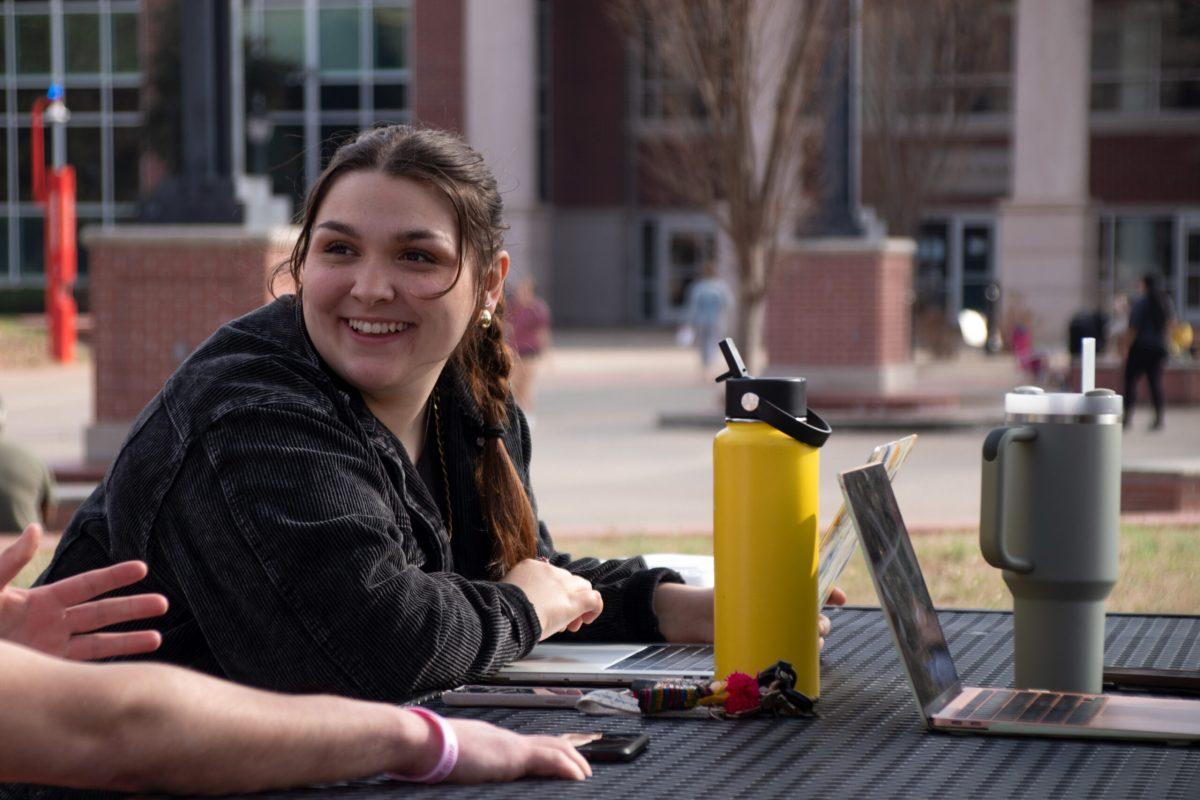
MT Lambda, an LGBTQ+ student organization at MTSU, held the 2026 LGBTQ+ Conference on April 3 at the Keathley University Center.
This year’s theme, All Identities: Unapologetic Existence, is a nod to some of the anti-LGBTQ+ bills that are being considered or have already been passed in Tennessee, including a bill that would make a statewide database of all trans residents.
Rio Martinez, the president of MT Lambda, said this year’s conference was difficult to organize due to restrictions placed on the organization, but said it was important to show up for the community in the wake of anti-LGBTQ+ bills.
“We knew we had to show up for the community and let everyone know that we are not afraid to take up space,” Martinez said in his opening speech. “We are not afraid of anti-trans bills, crackdowns on DEI, or any group trying to discredit our work. When faced with adversity, we embrace community and fight for our right to exist.”
A panel opened the event, consisting of three professors and a graduate student from the University of Memphis who worked on different studies regarding issues affecting the LGBTQ+ community.
William Langston, a psychology professor and faculty advisor for MT Lambda, presented a study about belief and misinformation.
One example of misinformation that Langston focused on was the lie spread in the 2024 election by then-candidate Donald Trump that kids could come home from school with a sex change operation.
Langston stated that this lie has consequences in potentially fueling anti-trans violence, which accounted for over half of the 932 anti-LGBTQ+ incidents that took place between 2024 and 2025.
This can be seen in MTSU’s annual Trans Day of Remembrance ceremony, of which Langston showed pictures.
“Each of those bags is a person, except for the ones where the numbers are so large that each of those bags might be 30 or 40 people,” Langston said. “And every year, we have to add a bunch more bags to the celebration because a lot more people are hurting. These lies are consequential.”
Sage Chevrette, an associate professor in communication studies, presented her study with Savannah Brewer, a recent MTSU graduate who is currently a full-time M.A. student at the University of Memphis. Their study focused on lesbian voices through poetry.
The duo opened their presentation by offering examples of negative effects on the lesbian community, such as the media portrayal of lesbian relationships being unstable and tragic, anti-LGBTQ+ legislation in the political arena and some religions deeming lesbian identity as a sin, causing shame and secrecy.
“The fact that these stories are still marginalized and invisibilized in the LGBT historical past,” Chevrette said. “But then they also are an important part of our present and the context in which we’re facing anti-LGBT legislation targeting us, unfortunately.”
Brewer then read a compiled poem titled “Echoes of Secrecy,” about the challenges that lesbians face and some of the spaces that let them escape those roadblocks, even if just for a day.
“You could lose your job if they found out,” Brewer said. “[But] in the bars, in the marches, in the music, we found spaces where we belong.”
Brewer also discussed all the data that she and Chevrette had to sift through for this study.
“We had over 138 pages of data, and it took me hours to compile this poem,” Brewer said. “But I think that it’s so incredibly important, and I am glad that we were able to share it with you guys, that we could hear their voices through us. And for LGBTQIA+ communities, it connects the past and present to the current backlash that we’re facing.”
Brewer also offered words of support to the trans community.
“There is significant backlash against the trans community right now, and the only thing that we can do as lesbians is to help rally with you guys and do everything that we can in our power to help empower you guys,” Brewer said. “This also offers generational visibility and belonging because during this time period, they didn’t feel seen. They weren’t allowed to feel seen.”
Eric Hughes closed out the panel by reading his research paper regarding the AIDS crisis and its meanings.
Hughes discussed several examples related to AIDS or AIDS activism, such as the stigma Brryan Jackson, whose father injected him with HIV-tainted blood, faced in his small town and novels like “Outgiving Zanians Like a Love Story” and “The Vista.”
“We should consider why these writers want to dwell on a tragic moment in our collective history that seems oppositional to the narrative of queer progress exemplified by, for example, the legalization of same-sex marriage,” Hughes said.
Hughes also talked about how we’re still feeling the effects of the AIDS crisis.
“The AIDS crisis is the moment that is still with us today and cannot be quarantined for the past,” Hughes said. “Heather Love talks about the benefits of engaging with bad aspects of our past, as she concludes, ‘Insofar as the losses of the past motivate us and give meaning to our current experiences, we’re bound to memorialize them, but we are equally bound to overcome the past to escape its place.’”
Hughes then left the audience with a quote from the late LGBTQ+ activist Vito Russo’s “Why Do We Fight?” speech.
“Someday, the AIDS crisis will be over,” Hughes said, quoting Russo. “Remember that. And when that day comes, when that day has come and gone, there will be people alive on this earth who will hear the story that once there’s a terrible disease in this country and all over the world, that a brave group of people stood up and fought, and in some cases gave their lives, so that other people might live and be free.”
To contact the news editor, email [email protected].
For more news, visit www.mtsusidelines.com, and follow us on Facebook at MTSU Sidelines and on X and Instagram at @mtsusidelines. Also, sign up for our weekly newsletter here.