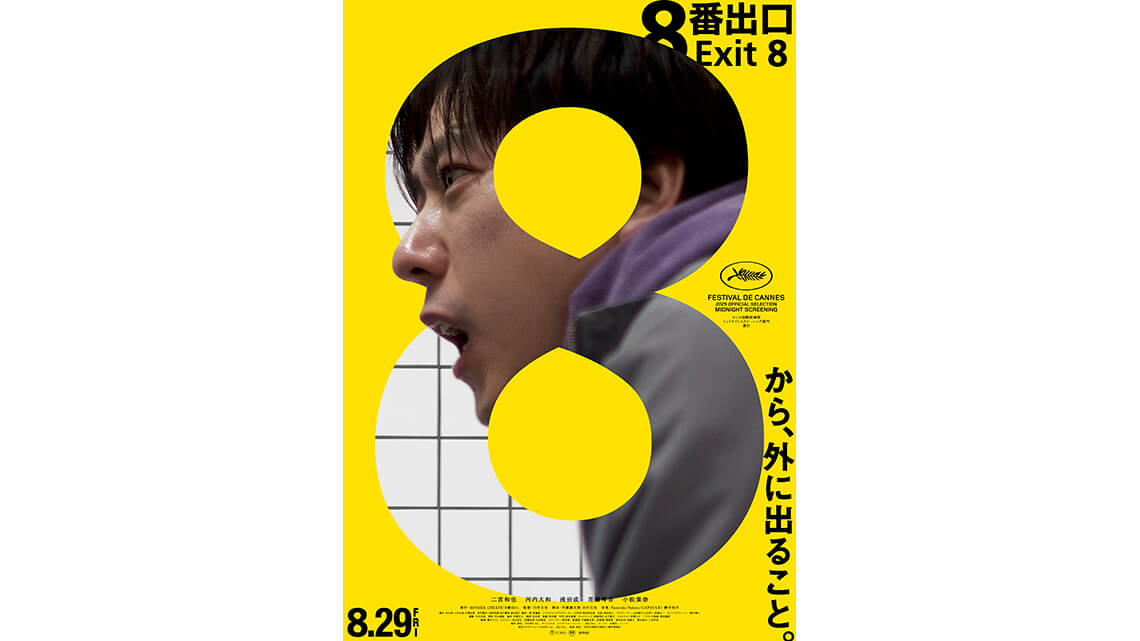
After the release of “The Exit 8,” a minimalist indie horror game built on repetition and unease, its film adaptation arrives with a difficult task: turning an intentionally sparse experience into a fully realized narrative.

The tiled hallway lined with posters and the lone, walking man — a familiar image to players — debut on the big screen in “Exit 8.” It’s an immediate visual callback that signals a faithful recreation of the game’s setting and one that captures its distinct atmosphere.
The original game thrives on isolation. Its liminal space, paired with subtle “spot-the-difference” mechanics, creates a constant, suffocating anxiety. Small changes — a shifted ceiling light, an altered poster, or the sudden appearance of something that doesn’t belong — drive the horror. The experience relies on restraint, favoring psychological tension over direct scares.
The film takes a different approach, attempting to construct a narrative from a game that offers little explicit story.
Themes of fatherhood and sacrifice are introduced, giving the protagonist emotional stakes absent in the source material. At times, this added characterization strengthens the experience, providing a reason to stay invested beyond the unsettling environment.
One standout plot point expands on the game’s world in a way that feels rewarding, offering backstory to elements that were previously left ambiguous.
However, these additions are inconsistent.
Rather than maintaining the game’s slow-building dread, the film frequently leans into more direct, conventional horror. Some newly introduced anomalies feel less like natural extensions of the game’s design and more like generic genre inclusions. Where the game leans on ambiguity, the film often opts for blatancy.
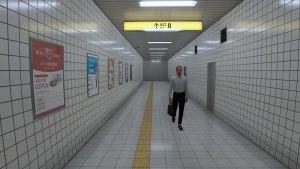
Even small continuity changes stand out in a film based on object-recognition. The recurring posters feature some different artwork than in the game, which is a minor detail, but one that feels unnecessary and distracting for those familiar with the original.
Despite subtle changes to the game’s staples, the film’s intent is clear.
“Exit 8” reflects a genuine effort to translate an indie horror experience into a cinematic format. There is visible care in how its world is adapted, even if not every creative choice lands.
Outside of its connection to the game, though, the film struggles to fully stand on its own. Its strongest moments rely heavily on recognition, and without that familiarity, some elements lose their impact.
In its intense focus on honoring the source material, some narrative threads get lost in the attention to detail. The protagonist’s asthma, for example, is introduced early when he loses his inhaler, but the plot point is never meaningfully revisited. These smaller details are easy to gloss over, but can linger as distractions for viewers.
For those familiar with the looping hallway and the dread of seeing “Exit 0,” however, “Exit 8” offers a compelling, if imperfect, adaptation — one that may not fully escape its source material, but remains worth the journey.
Whether stepping into the hallway for the first time or revisiting it on screen, “The Exit 8” is available to play now, with the film adaptation “Exit 8” currently in theaters.
To contact the features editor, email [email protected].
For more news, visit www.mtsusidelines.com, and follow us on Facebook at MTSU Sidelines and on X and Instagram at @mtsusidelines. Also, sign up for our weekly newsletter here.