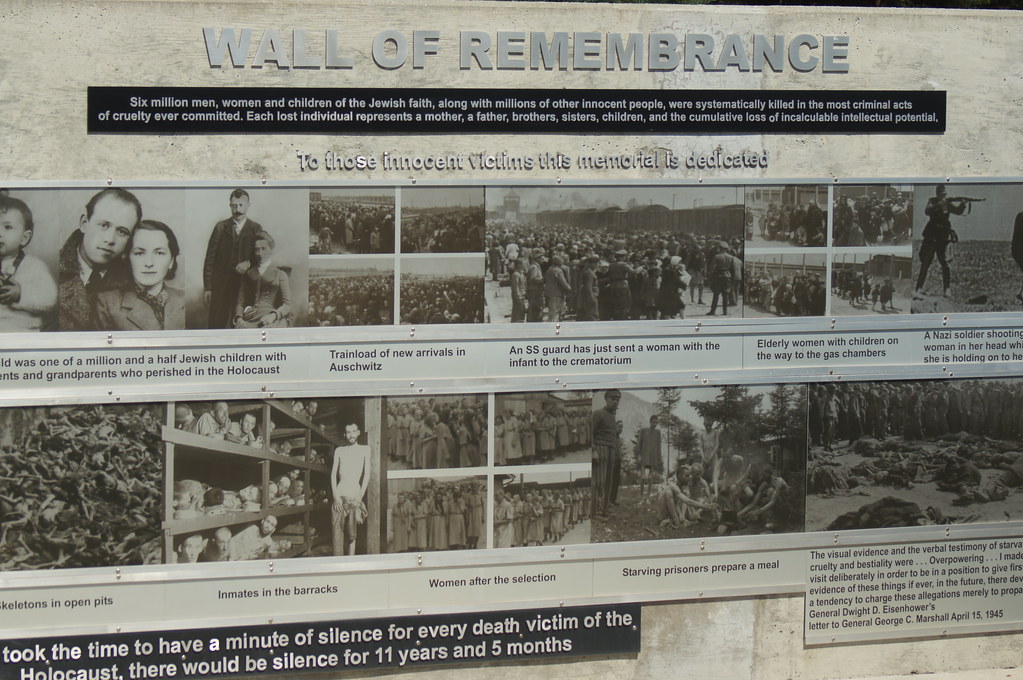
George Rishfeld was a child when his parents told him he was going to be thrown over the barbed wire fence of the Vilna ghetto and into the arms of another family. He did not know there was a war going on. He did not know anything about Adolf Hitler or concentration camps.
The Tennessee Holocaust Commission invited Rishfeld to speak in the Ned McWherter Learning Resources Center for Holocaust Remembrance Day on April 15.
MTSU’s Holocaust Studies Program students organized the event, which had 155 attendees, according to Ashley Valanzola, the faculty organizer.
“This is actually one of the bigger events that we’ve had – It was all their efforts to plan something like this,” Valanzola said.
A Life In Hiding
Richard and Lucy Rishfeld had their first and only child in 1939 in Warsaw, Poland.
“The difference between me and some survivors [was] my age,” George said. “I was too young to fight, too young to be put in a labor camp.”
At the time, Poland contained the largest Jewish population. Soon after his birth and during the Nazis invasion that initiated the beginning of World War II, his parents fled Warsaw and made a pact with the Franchevitz family to take him in.
“They gave me so much love and warmth,” George said. He eventually called them “mama” and “papa.”
His parents and the family agreed that no matter what happened to them, George would be protected. The arrangement between the Rishfelds and Franchevitzes was that if one or both of George’s parents survived, he would be returned to them. If not, he would be brought up by the Franchevitzes as a Catholic.
Nazi officials soon began rounding up citizens into the Vilna ghetto. George’s parents were able to secretly get him to safety by throwing him over a barbed wire fence to Helinka Franchevitz, the family’s daughter.
“My parents, the only thing they wanted was to save me,” George said.
While separated from his parents, George lived hidden with the Franchevitzes for three years. The family raised George in an apartment in Warsaw and kept him out of sight from Nazi officers.
“You must understand that the people who were harboring children or adults – they were in as much danger as the person that they were hiding,” George said.
George recalled a story of how he hid underneath a bed while a Nazi officer ransacked the apartment. The family draped a blanket over the bed while George hid underneath. They told him that the men outside the apartment were the “bad men” who took away his mother and father. Every time Nazi officers searched the apartment, he played a game of deadly “hide and seek.”
“The Nazi patroller checked the bed, but had he fully checked underneath, I would not be here today,” George said.
George described frequently having nightmares and PTSD flashbacks due to his constant hiding from Nazis sweeping the apartment.
Reunion
One day, when Mrs. Franchevitz left to go grocery shopping, she instructed George once again to never go to the door. But this time was different. She told him, “Do not open the door, even if it is your father.”
When two men approached the door, George recognized his father with another escaped man. They had been two of the only survivors from the ghetto. George cried and asked where his mother was, whom they both thought to be dead.
But his mother was alive. Lucy Rishfeld had been sent to a factory to make clothing for the soldiers. She lived because she appeared younger than the other women in the ghetto, and knew how to sew. When United States General Eisenhower liberated the camps and ghettos, Lucy was freed.
A group of Russian soldiers took Lucy to a train platform in Lithuania, where she saw her husband again for the first time.
“It was like a scene from a movie,” George said.
Lucy Rishfeld stood on the platform, thinking her husband was surely dead, when a clean-shaven Russian officer approached her. Only when she looked him over did she realize it was her husband. They said each other’s names in disbelief, ran up and hugged one another.
“Then my mother steps back and smacks my father across the face,” George said with a laugh. “She says, ‘How dare you look so good?’”
She had lost weight and was without shoes from the linen factory, where women wore paper on their feet. Her husband, on the other hand, had cleaned himself up after escaping from the ghetto in 1943 and living in hiding in a cave for two and a half years.
George and his family reunited and stayed with the Franchevitzs for about five more weeks before living in a displaced-persons camp.
Begin Again
In 1949, George and his parents moved to the United States and settled in Manhattan. George’s life as an immigrant after the war wasn’t easy. In school, George remembers being constantly teased by his peers.
“I recall one of my teachers introducing me to the class as a ‘refugee boy from France’, neither of which was true,” George said. “They would say to me, ‘we don’t need any foreigners, we’re American, get the heck out of here.’”
Despite challenges, George graduated high school at 17 years old and immediately sought to enlist and defend his “adoptive country.” He joined the National Guard in 1957 and later returned to New York after his enlistment ended.
Honoring the Past
Today, George and his late wife, Pamela, have two daughters and six grandchildren. He dedicates himself to educating others, spreading awareness about antisemitism and always remembering the Holocaust’s impact.
“I believe that one of the reasons I survived was so that I could go out and tell the story,” George said. “So that people would know that the Holocaust wasn’t a Hollywood creation.”
At the end of the event, the audience asked George questions about antisemitism in the current world and how to combat it. He said antisemitism cannot be eradicated, but there are solutions to help extinguish harmful flames.
“Every minority is feeling it,” he said. “Talk to people – know what you’re talking about, forget about the word hate and educate others to help bring the fire down.”
To contact the news editor, email [email protected].
For more news, visit www.mtsusidelines.com, and follow us on Facebook at MTSU Sidelines and on X and Instagram at @mtsusidelines. Also, sign up for our weekly newsletter here.