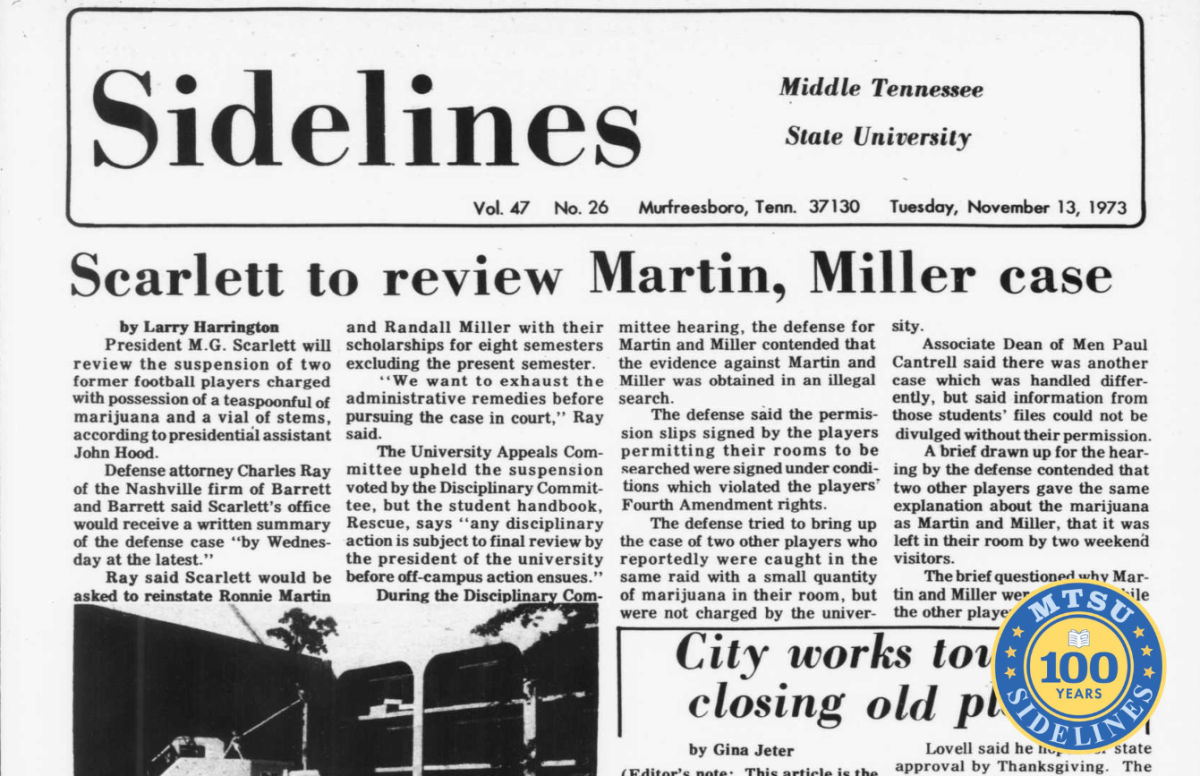
This is a story that ran in the Sidelines 100th Anniversary Edition newspaper, a print edition meant to commemorate the 100th anniversary of Sidelines.
Like many public universities across the country, MTSU’s tuition increases each year in order to account for operational costs and state funding, but it can be difficult to understand what makes up the bulk of tuition.
MTSU’s base tuition is divided into two categories: the tuition itself and program service fees. Tuition covers the university’s general operations, whereas program service fees support non-academic student services. The total cost of attendance combines base tuition, program service fees and all additional feels like housing or meal plans.
The MTSU Board of Trustees Finance and Personnel Committee Tuition oversees fee increases. The Student Government Association has the opportunity to voice approval or disapproval of a potential increase, but it doesn’t have a direct vote on increases.
The MTSU Board of Trustees approved an increase to mandatory program service fees for the 2025-26 school year in June 2025. Sixty-four dollars of the $97.50 increase was allocated to MTSU Athletics.
As of the 2025-26 school year, full-time students at MTSU paid a total of $1,128.50 in program service fees. Athletics, which received $377, accounts for about 33% of the total amount.
SGA did not approve of the increase to the athletics fee. The athletics department did not engage with students or the SGA at any point during the process, marking the second time that a proposed athletics fee increase has been submitted without any student input or transparency, according to a statement released by SGA in May 2025.
“Our responsibility is to bridge the gape between the students and the administration when it comes to student issues,” SGA president RJ Ware said. “Maintaining a healthy relationship with administration to advocating for your fellow students before the board when necessary, and building the relationships you need are important to do well in this job.”
SGA only approves of program service fee increases if it is put toward a service that directly benefits students, Ware said.
Now that students at MTSU have paid the full tuition amount, many have developed negative opinions about the fee increase.
“I feel like more of it should go toward other programs, especially since some of the teams are obviously not as good, from my personal opinion,” Elenor Britton, a freshman environmental journalism major, said. “MTSU has much broader departments with other aspects, especially the fine arts. More of that should be put towards that stuff over more sports-related things because they fund them enough already.”
However, some students were content with the increase.
“It kind of hurts a little bit to see tuition go up, but football is the magnet for most colleges, and I don’t think it’s a terrible investment if we get some upgraded equipment,” Lincoln Montgomery, a freshman pro-pilot major, said. “I think that MTSU is at a pretty good price. It’s not too overprice. It’s not too underpriced. I think it’s alright.”
Despite the changes to tuition, MTSU remains an affordable university compared to in- and out-of-state alternatives. Counting the base tuition cost and the program service fees, MTSU’s total tuition was $5,328.50 for in-state students. For comparison, the average in-state tuition for Tennessee universities was $10,806 in 2025. The national average of in-state tuition was $11,375 for the 2025-26 school year.
Among the three largest public state universities, MTSU has the lowest tuition rates. Tuition and fee increases have been modest in recent years in an effort to keep degrees attainable with minimal student debt, according to the Notice of 2025-26 Undergraduate Tuition and Fee Increase Proposal.
To contact the Sidelines 100 editor, email sidelines100@mtsusidelines.com.
For more news, visit www.mtsusidelines.com, and follow us on Facebook at MTSU Sidelines and on X and Instagram at @mtsusidelines. Also, sign up for our weekly newsletter here.