This is a story that ran in the Sidelines 100th Anniversary Edition newspaper, a print edition meant to commemorate the 100th anniversary of Sidelines.
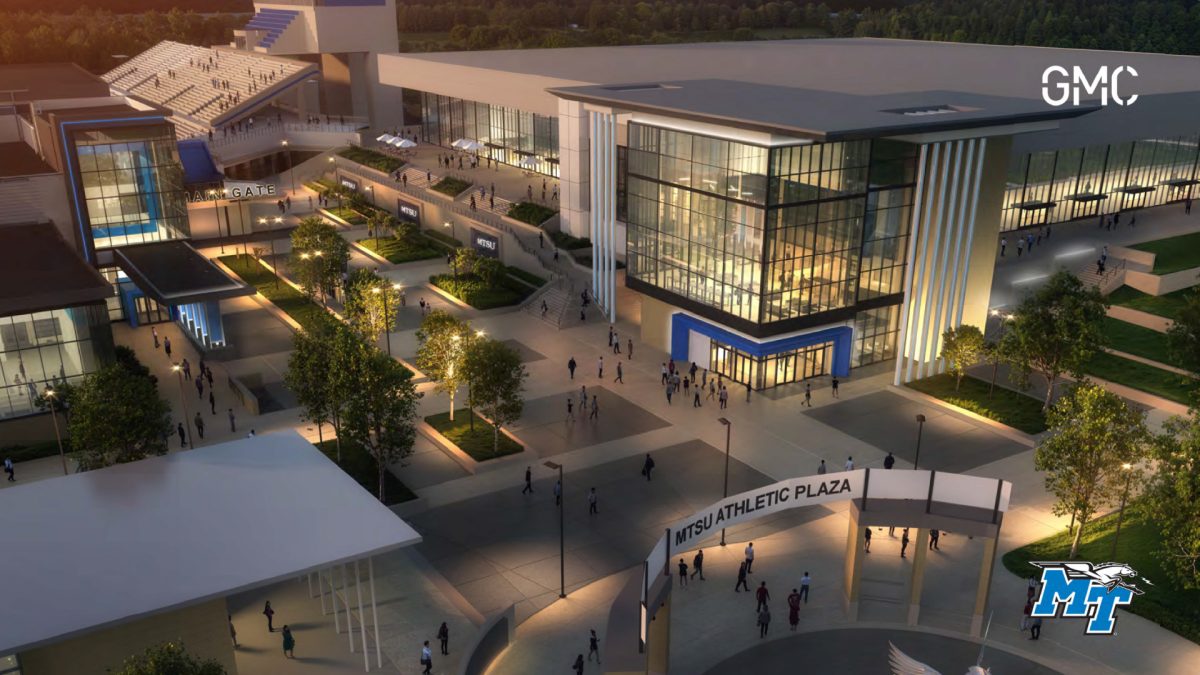
As is a common occurrence on college campuses, MTSU continues to expand throughout Murfreesboro, regularly announcing new projects, groundbreakings and ribbon cuttings.
Though each new project may come as a surprise to most people, MTSU maps out the future of campus in its master plan that lasts for 10 years. This year, the campus planning department is working on the newest version as the 2016 plan comes to a close.
Since 2016, the campus has seen a substantial increase in concrete within the construction of new buildings, and in some areas on campus, it’s one of the only materials seen on the ground and in the buildings’ architecture.
Though it creates a cohesive architectural composition on campus, concrete can heavily affect the environment, as it emits greenhouse gases and increases the temperature in areas where it exists, Alisa Hass, a professor of geography with specializations in climate change and climatology, said. These areas of increased temperature are called urban heat islands, and they mostly affect cities where there is a concentrated amount of pavement and concrete.
For campus, Hass said this heat island effect is most noticeable in parking lots during the summer.
“It can get really scorching hot just to try to walk across campus, which then is going to be affecting our health,” Hass said. “… If we have warmer temperatures, it increases energy use as well. So, we need more energy to cool off the buildings, and then we end up having issues with that as well.”
Campus planning is trying to offset any possible negative effects further campus growth could have on the environment, Bill Waits, the assistant vice president for campus planning, said. Some of these offsets come from the state and federal government, but others are done by MTSU.
Tennessee law has necessitated new builds to follow High Performance Building Requirements since 2015, which allows buildings to use “points” for things like land management, site selection, water efficiency, heat island reduction and more.
“Unfortunately, it’s hard to build a building without concrete,” Waits said. “It’s almost impossible, really, to be honest with you.”
MTSU makes an effort to offset its carbon footprint from construction and concrete by prioritizing energy-efficient buildings — which are also cheaper in the long run. Reusing materials from old buildings, preserving trees and other biodiversity and running the campus cogeneration plant burns natural gas and produces energy. The plant also produces heat as a byproduct, and in the winter, MTSU uses it to heat water, buildings and other things around campus.
A feature on the newer School of Concrete and Construction Management building is a green roof, and Waits said it is a case study to see how the added plants could offset heat from the concrete and building.
The campus is also a certified arboretum — a living museum of trees — with 73 species of native and non-native trees recognized on an arboretum map. MTSU’s Center for Energy and Sustainability and the Biology Department contribute to increasing the biodiversity of the campus, both for aesthetic and beauty purposes and for cooling, shade and oxygen purposes.
In recent years, campus planning improved at working with environmental organizations in the development process, Kim Sadler, the MTSU Center for Environmental Education director, said.
“Care has been taken,” Sadler said. “People who are responsible for making those decisions, they’ve done a good job reaching out.”
To contact the news editor, email [email protected].
For more news, visit www.mtsusidelines.com, and follow us on Facebook at MTSU Sidelines and on X and Instagram at @mtsusidelines. Also, sign up for our weekly newsletter here.