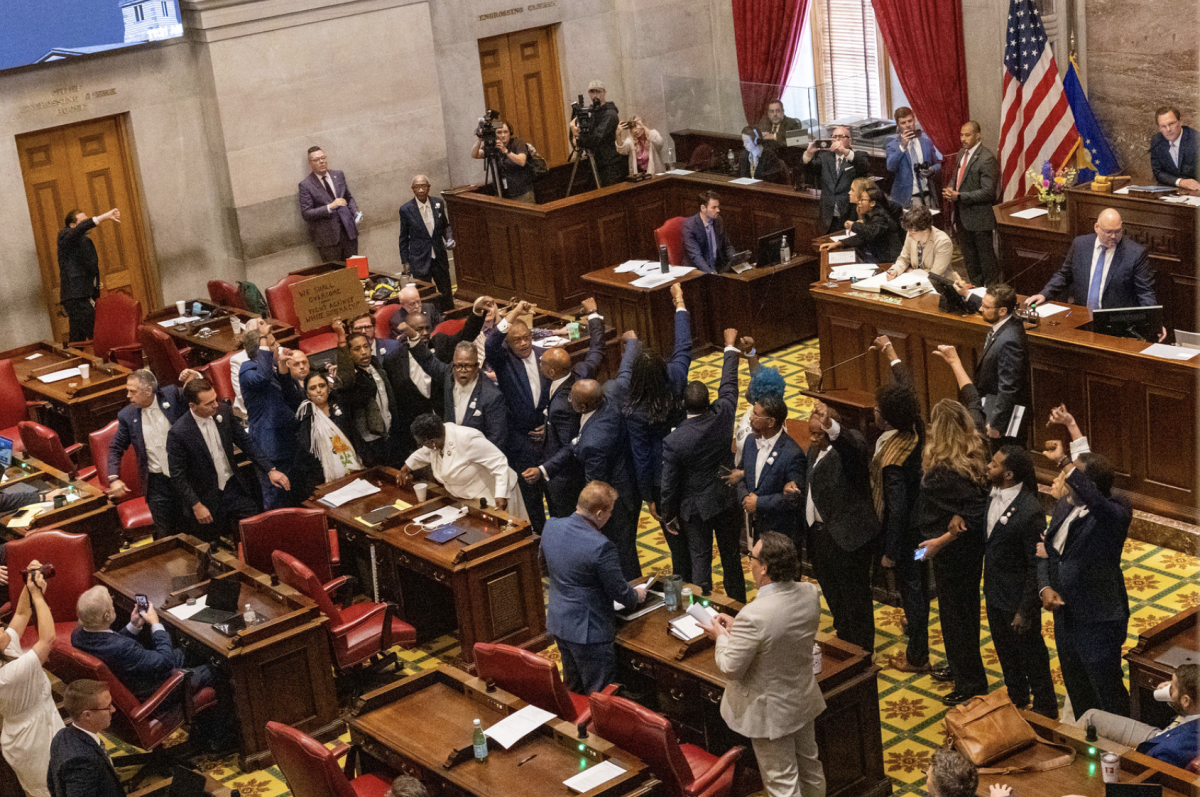
Protestors and lawmakers packed the Tennessee State Capitol on Wednesday as the General Assembly convened for the second of a three-day special session to redraw the state’s congressional map.
Speaker of the House Cameron Sexton and Senate Majority Leader Jack Johnson filed House Bill 7003 and Senate Bill 7004 this week to redraw Tennessee’s districts, saying the changes aim to “ensure the state’s representation in Washington reflects its conservative values.”
The decision to redistrict comes after the Supreme Court weakened the Voting Rights Act on April 29, ruling that a congressional map drawn in Louisiana was racially gerrymandered.
Gerrymandering is a practice used by lawmakers when drawing congressional districts that can manipulate areas to favor a certain party or candidate.
Following the ruling, Conservative Justice Samuel Alito wrote that “allowing race to play any part in government decision-making represents a departure from the constitutional rule that applies in almost any other context.”
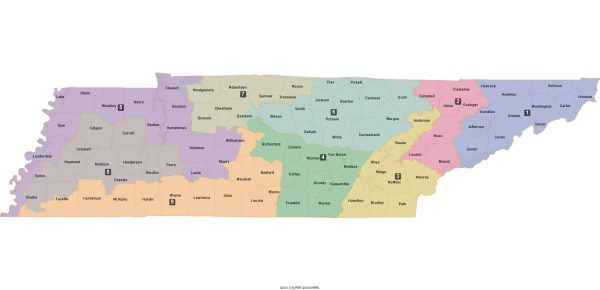
Lawmakers unveiled the proposed congressional map on Wednesday morning, which, most notably, splits Memphis, Tennessee, into three districts and flips District 9 Republican. The ninth district is majority-black, and is currently Tennessee’s only Democrat-held congressional district.
Rutherford County will be split into two districts, but it is unclear which district fits MTSU.
Under the proposed map, District 9, located in Shelby County, would span from the Southwest corner of Tennessee to Williamson County.
But to establish this new map, state Republicans must repeal state law 2-16-102, which establishes that congressional districts may not be changed during apportionments.
Senate Bill 7002, which repeals the law, passed the committee on Wednesday morning, clearing the way for redistricting to begin.
But many lawmakers and protestors rebuke the redistricting, raising concerns about voter suppression and racial discrimination.
Senator Charlane Oliver (D- District 19) opened the Senate Floor session by emphasizing the history of racial discrimination in Memphis, highlighting the Memphis Massacre of 1866, which was a series of violent attacks on the Black American community.
“The first thing you did after the Civil War was go and target black people,” Oliver said. “And you’re doing it today. You killed them, you murdered them, you mutilated them and you took their property. And then you claimed we are the ones that can’t pull ourselves up by our bootstraps. You took the bootstraps.”
Political scientist and retired MTSU professor Sekou Franklin spoke as a witness in opposition to SB 7002.
“This plan, or this effort, renders Shelby County and black voters in Memphis invisible,” Franklin said.
Following the passage of SB 7002, protestors were disappointed, but not surprised.
“I’m not surprised, I don’t think anybody here is,” Destiny James, a member of Tennessee Advocates for Planned Parenthood, said. “We already knew the outcome before we even came here yesterday; we knew the outcome as soon as the Supreme Court case came in.”
Tiffany Perkins, a protestor and member of Civic Tennessee, agreed.
“It’s not surprising, but it is disheartening,” Perkins said.
Chants of “klan, klan, klan” interrupted Perkins, echoing through the halls of the Capitol and following lawmakers out of the committee hall.
Perkins joined the chants, saying that the ruling is blatant disenfranchisement and “definitely very racially motivated.”
Congressman Steve Cohen further emphasized the racism of the legislation, likening the redistricting proposals to Jim Crow, aiming to disenfranchise Black American voters.
“Jim Crow comes in, and legislators that might not think they’re racist, but do things that are racist because of the impact,” Cohen said. “It’s not conservative to come up here and take a 56-year-old law that says you don’t redistrict during censuses, and just cast that aside.”
Samson Cook, a protester visiting from Tennessee State University, had concerns about how the redistricting would affect schools in Memphis, and said he was protesting to ensure students in Memphis remain represented.
“There are a lot of students that come from Memphis,” Cook said. “So as a student advocate, a student representative, I feel like it’s very, very, very, very important that we ensure that those students have representation back at home.”
Protestors left the Capitol building, chanting “we’ll be back,” vowing to return tomorrow to the legislature to continue efforts to derail the proposed redistricting.
“It’s just a matter now of making our voices heard and making sure they know we’re not happy about this, and we’re not backing down, and they’re not gonna move forward without us,” James said.
To contact the news editor, email [email protected].
For more news, visit www.mtsusidelines.com, and follow us on Facebook at MTSU Sidelines and on X and Instagram at @mtsusidelines. Also, sign up for our weekly newsletter here.