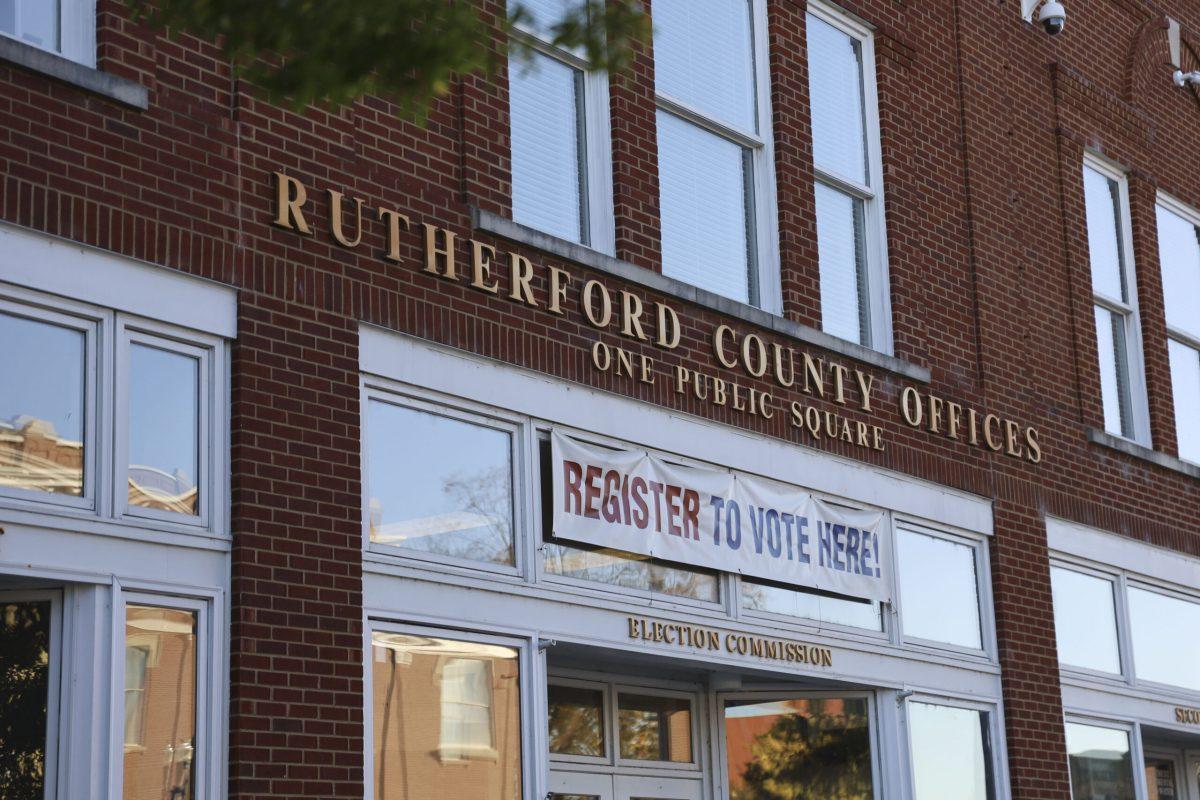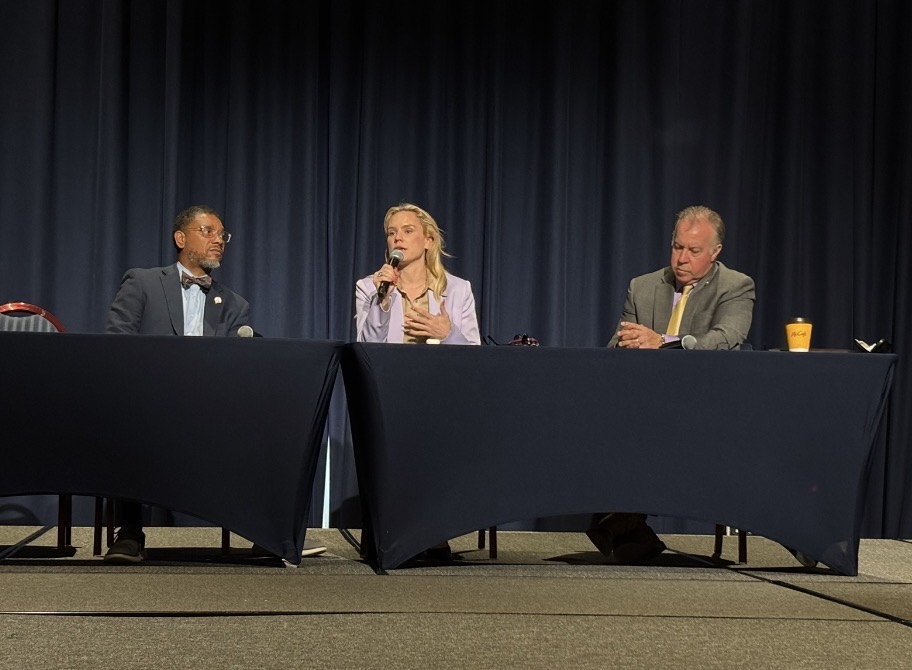
The Mu Zeta Chapter of Omega Psi Phi Fraternity presented a nonpartisan civic engagement forum on Thursday. Panelists answered questions and discussed the importance of civic engagement and conversation.
Panelists included Rep. Aftyn Behn (D- House District 51), Rep. Vincent Dixie (D- House District 54) and Rep. Mike Sparks (R- House District 49).
Sidney Ware, Vice Basileus of the Mu Zeta Chapter, opened the discussion by emphasizing the importance of civic engagement among young people.
“Young people make up one of the largest voting blocks in this country, yet turnout among our age group continues to lag behind past generations,” Ware said. “Policies being decided today directly impact our education, our financial futures and the communities we come from. So, whether you choose to engage or not, the question is not whether this matters, but it is a question of ‘will we choose to be part of it?’.”
The purpose of the panel, Ware said, is not just to observe, but to engage and remember that every vote counts.
Why should young people care about what’s happening at the state and local level?
Young people are the future and will be the stewards of change, Behn said.
“In the next 20 years, there will be more transformative change seen in this country since the New Deal,” Behn said. “And [young people] will be the stewards of that.”
There will be “a vacuum of elected leadership” because of the “gerontocracy” leaving office, and young people will have to start running for boards, commissions and local offices to account for the shift in power.
Young people need to understand that politics affects them, Dixie said. They need to be educated.
“People say ‘oh, I’m not involved, I don’t do politics,’” Dixie said. “But if you don’t do politics, politics is going to do you. So, you better learn to pay attention and pick up a newspaper.”
Eighteen to 25-year-olds make up a huge voting demographic, Dixie said. And if even a quarter of them start voting, it could sway elections either way. But when Dixie talks to young people, a majority say they don’t vote because they don’t understand issues.
Young people need to find mentors in politics, Sparks said. And they need to “raise hell” for issues they care about. Sparks also highlighted nonpartisan cooperation.
“Me and you young cats here, we got a whole lot more in common than we don’t have in common,” Sparks said. “I promise you that.”
For students who feel like their voices aren’t heard, or who don’t even know where to start in politics, what are ways for them to be civically engaged?
A good way to start is to get an internship, Behn said. Learn how to participate in campaigns and organize within the community.
“Finding things you’re interested in, finding the groups that organize around them, is wonderful,” Behn said. “Find a candidate you care about, … and ask if there are internship opportunities.”
Dixie highlighted the importance of speaking up and speaking out.
“If you don’t speak up and speak out, then nothing’s ever gonna happen,” Dixie said. “Nobody ever says, ‘man, I have too much power, I’m going to give some away.’ You have to take it.”
Sparks said that, as a young person working at a Nissan factory, he spent a lot of time volunteering and working to fina a place at the table.
“I would volunteer up front at Nissan, and anytime I could be at a conference table, I would be there,” Sparks said. “I’d volunteer for the civic engagement community [and] any other committees they offer.”
What decisions being made right now will have the biggest impacts on young people in the next five to 10 years?
Behn highlighted the affordability crisis, the poor job market and how the “American dream” is no longer very attainable.
“You all are entering a job market that is automated, that is run by tech oligarchs that haven’t raised the minimum wage,” Behn said.
Life is hard for young people now, Behn said, but there will be “a major pendulum that swings.”
Dixie said the biggest issue facing young people is a lack of caring, cooperation and respect.
“We’re going to have to get back to a point of caring about each other, about being each other’s brother, being ‘my brother’s keeper,’” Dixie said. “Because, if we continue down this road, it’s so divisive.”
Young people will have to decide “what kind of country [we] want to be.”
Sparks said that the most powerful tool is forgiveness, and it’s how young people will usher in the future.
How can voting accessibility on campus improve?
“Now is the time for imagination,” Behn said. “Thinking about what would make voting access easier.”
Dixie suggested using student IDs as voting identification.
“I think it’s crazy that you can’t use your student ID as identification,” Dixie said. “It’s coming from a state-accredited university, and it’s truly a government identification.
There isn’t a problem with voting access, Sparks said. People just need to decide to vote.
“I think the accessibility is pretty easy, so I finally have an opportunity to disagree with you all,” Sparks said. “But you need to make it a priority. It’s kind of like, if you want a cup of coffee, you’re going to go get it. If you want to vote, you can make it happen.”
All panelists emphasized the importance of voting, with Dixie highlighting that people “lost their lives” for the right to vote, and not to abuse that right.
To contact the news editor, email [email protected].
For more news, visit www.mtsusidelines.com, and follow us on Facebook at MTSU Sidelines and on X and Instagram at @mtsusidelines. Also, sign up for our weekly newsletter here.