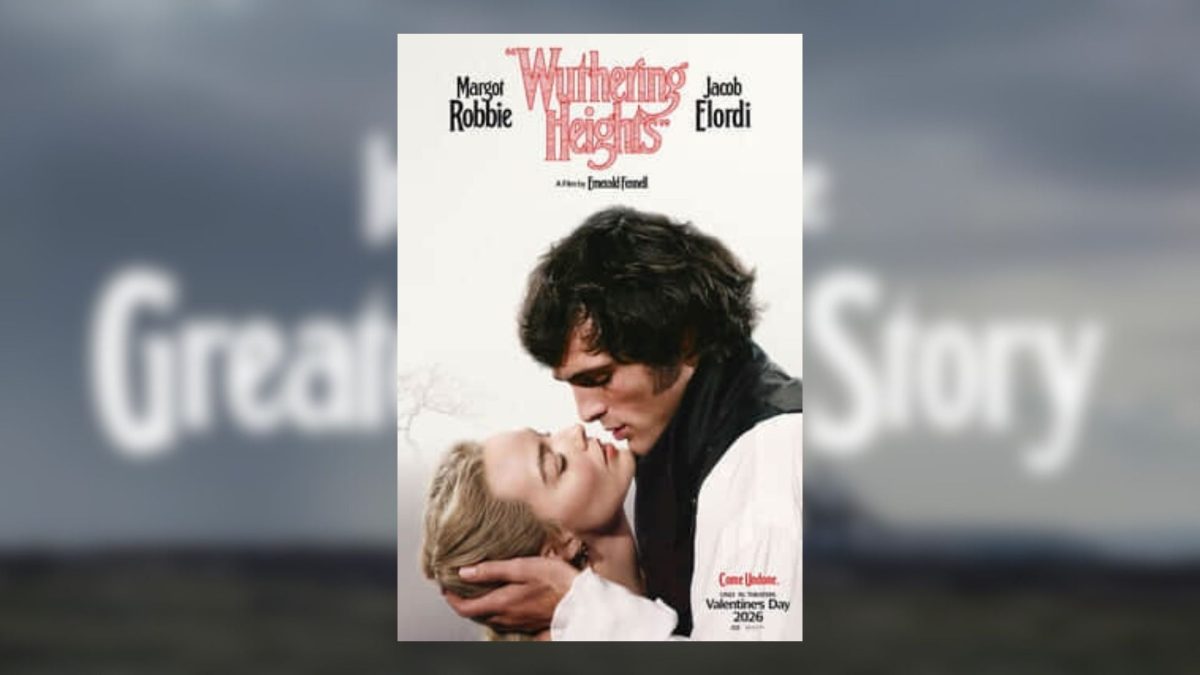
Emerald Fennell’s “’Wuthering Heights’” hit theaters Feb. 12, ushering in Valentine’s Day weekend with Catherine and Heathcliff’s tumultuous and passionate relationship on screen.
So far, the movie’s success is palpable– an impressive $3 million in sales on its preview day and $34.8 million since then. While the film has a 63% rating on Rotten Tomatoes, audience approval ratings are 81%, suggesting mixed opinions.
Discussions surrounding the film center on Fennell’s integrity to the Emily Brontë novel. The director told Entertainment Weekly that she wanted to make an “interpretation to [the] book and to the feeling of it.”
A common criticism of the interpretation Fennell depicted included the overt changes to the plot. Fennell also stated that “. . . if you’re making a movie, and you’ve got to be fairly tight, you’ve got to make those kinds of hard decisions” – referring to these alterations.
What were some of the changes?
While the movie carried elements of the basic plot of Brontë’s novel, it varied from the book in several ways.
The characters
The lead roles of Catherine Earnshaw and Heathcliff were played by actress Margot Robbie and actor Jacob Elordi. When this was announced during the movie’s production stage, many people voiced their concerns online.
According to the novel’s descriptions, the character of Heathcliff is portrayed as “dark-skinned.” Heathcliff is also shamed for his disposition and “otherly” nature, characters in the novel calling him racial slurs associated with Romani people at the time.
Much of the verbal and physical abuse Heathcliff suffered related back to his race, causing him to spiral into the vengeful, sadistic villain he becomes during the novel.
Seeing a white actor play Heathcliff is not uncommon in adaptations of “Wuthering Heights,” but people still criticized Emerald Fennell’s choice.
Fennell responded to The Hollywood Reporter, “I think the thing is everyone who loves this book has such a personal connection to it, and so you can only ever make the movie that you sort of imagined yourself when you read it.”
United Kingdom-based Far Out Magazine said that Fennell’s take was “pure racial bias,” underlining the subjectivity that comes with imagining a white man in the place of a character who is described to be not white.
Another character adaptation change is Mr. Earnshaw, Catherine’s father. In the book, Mr. Earnshaw died when Catherine and Heathcliff were still teenagers, with no impact on the events that followed.
In the film, Mr. Earnshaw adopts the personality and actions of Hindley, the elder brother of Catherine and the childhood abuser of Heathcliff. Earnshaw died during a drunken episode shortly after Heathcliff returned to Wuthering Heights, similarly to how Hindley died towards the end of the novel.
Other notable changes include the shift in Edgar and Isabella Linton’s relationship from siblings to a wardship, and the depiction of Heathcliff and Isabella’s relationship as more consensual and sado-masochistic than in the book.
The story
The most obvious change in the movie is the exclusion of the events that occur after Catherine Earnshaw’s death.
“’Wuthering Heights’” ends with Elordi’s Heathcliff, nestled into the corpse of Robbie’s Catherine, the atmosphere a cold grey with brief glimpses into the characters’ warmer memories of each other.
What the film did not show was the last half of the story– Heathcliff’s torment of the children of Catherine, Edgar, and Hindley. Without their inclusion, the story is oriented less on his revenge and more on his and Catherine’s romance.
This is not the first time an adaptation excluded this part of the narrative, however. Several other adaptations of “Wuthering Heights“ never mention the characters’ children.
While the book portrays horrendous abuse and manipulation committed by Heathcliff to the children, the movies only show Heathcliff’s undying love for Catherine, which borders on obsession.
Critics say that portrayals of this kind not only remove the complexities of Heathcliff but also romanticize domestic abuse and toxic relationships built on possession and jealousy.
The intimacy
Trailers for Emerald Fennell’s 2026 interpretation called the original novel “the greatest love story of all time.” It was also no coincidence that the movie premiered on Valentine’s Day weekend, a holiday celebrating love and romance.
Emily Brontë’s novel depicted none of the erotic scenes shown in Emerald Fennell’s work. Regarding these interactions, Fennell told the Los Angeles Times, “They’re part of the book of my head. I think they’re part of the book in all of our heads. With all the love and respect and adoration I have for the book, I also wanted to make my own version that I needed to see.”
Interpretation, not adaptation
“Wuthering Heights” by Emily Brontë is not just a book about the romance and struggles of Catherine Earnshaw and Heathcliff. It is about a “cycle of violence,” according to Murray Tremellen, a curator at the Brontë Parsonage Museum.
Though “’Wuthering Heights’” from Emerald Fennell was not the most faithful book-to-screen realization of the novel, she restated her intentions for an interpretation, not an adaptation.
Fennell told Entertainment Weekly, “It begins where it ends and ends where it begins. And that’s the thing about love, and it’s the thing about the book, right? It’s about the depths of human feeling and how it exists in a profound way, not just a physical one.”
To contact the features editor, email [email protected].
For more news, visit www.mtsusidelines.com, and follow us on Facebook at MTSU Sidelines and on X and Instagram at @mtsusidelines. Also, sign up for our weekly newsletter here.